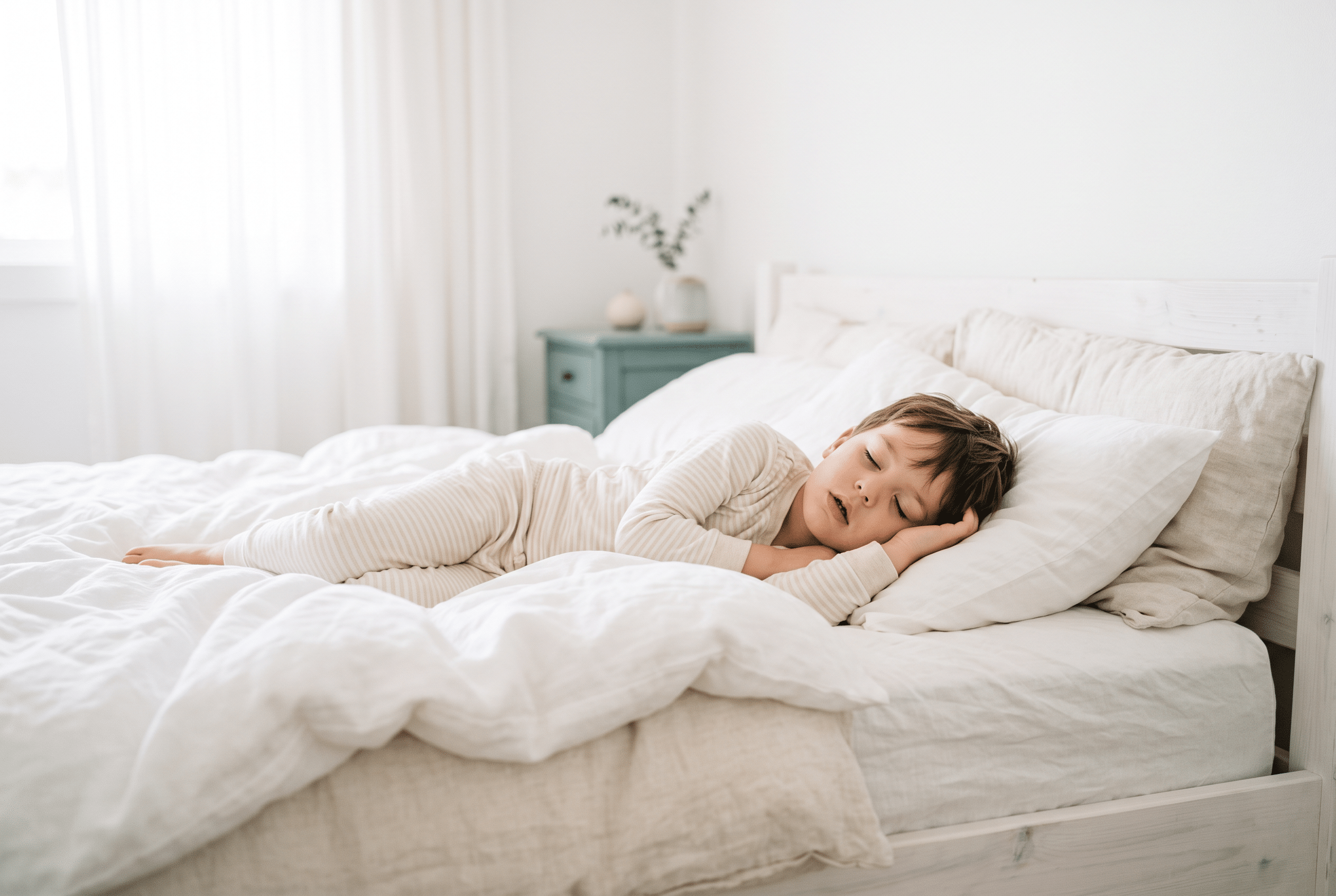
Snoring in children
Snoring in children is a sign, not a diagnosis in itself. It is the mild end of a spectrum that has obstructive sleep apnea at the other end, and the point of the examination is to show where on that spectrum your child is. The difference can't be heard in the noise, it shows in what the breathing does between the snores.
Simple snoring or blocked breathing?
Simple snoring is noise with no consequences. Your child sleeps through, breathes normally and wakes up rested, and needs nothing more than an assessment if it persists.
Obstructed breathing during sleep (obstructive sleep-disordered breathing) is more serious: here the airway narrows so much that breathing becomes genuinely difficult. What separates the two is not how loudly your child snores, but the following:
- Pauses in breathing lasting a few seconds, followed by a deep breath or a jerk
- Effort you can see in the chest and neck, as if they are pulling the air in
- Sleeping with the head tilted back, the mouth open and the neck stretched
- Waking up again and again, restless sleep, heavy sweating
- Bedwetting that comes back after it had stopped
A child who snores only when they have a cold doesn't belong here.
A child who snores almost every night, with or without a cold, does.
Why doesn't it show as sleepiness?
This is where almost everyone gets confused, and it is the reason the diagnosis is delayed for years.
In adults a bad night leads to sleepiness the next day, in children it does the opposite. A child who doesn't sleep well becomes hyperactive, irritable and finds it hard to sit still and concentrate. It looks like an attention disorder and is often put down to that, while the cause is in the airway.
Then the rest follows: slipping grades at school, morning headaches, trouble waking up. Long-term mouth breathing is also linked to changes in how the jaw develops, although the evidence there comes mainly from observational studies.
The practical conclusion is simple. When a child snores every night and is also struggling at school, the 2 are worth looking at together.
What can cause it?
The most common cause in children is large tonsils and adenoids, but it is not the only one, which is why the examination doesn't stop there.
- Large tonsils and adenoids, which narrow the airway at 2 different points
- A constantly blocked nose, from allergic rhinitis or a deviated septum
- Obesity, which adds weight to the tissues around the airway
- Features of the face and skull, such as a small or set-back lower jaw and a narrow upper jaw
- Neuromuscular conditions and syndromes, where muscle tone in the throat is reduced
In many children 2 or 3 of these are present together, and that changes the treatment. Removing the tonsils in a child with obesity and poorly controlled allergic rhinitis won't solve the problem on its own.
What happens at the appointment?
the history and the video
Your child doesn't sleep in the doctor's office, so the information comes from you. A 20 to 30 second video of your child asleep, where you can hear the breathing and see the chest, is worth more than any description. Also note how many nights a week it happens and whether it changes with sleeping position.
The examination
We check the tonsils with a simple look in the mouth, the adenoids with a small mirror at the back of the mouth or an endoscope, and the nose for blockage, swollen lining or a deviated septum. What matters is not the absolute size, but how much room is left for air.
The hearing test
It is done at the same visit, because the same cause that blocks the nose often blocks the ventilation of the ear as well. Many children who come in for snoring leave with a finding of fluid behind the eardrum that nobody had suspected.
When is a sleep study needed?
In most cases it isn't. The guidelines recommend it in 2 situations.
The first is children whose assessment must be objective before any surgery: children under 2 years old, and children with obesity, Down syndrome, abnormalities of the face and skull, neuromuscular conditions, sickle cell disease or mucopolysaccharidoses.
The second is any child where the need for surgery is uncertain, or where what the examination shows doesn't match what you describe. In other words, when the tonsils look small but the nights are hard, or the other way around, the sleep study settles the question.
Treatment
When the cause is the tonsils and adenoids
Removing them is the main treatment and in most children it improves sleep significantly. Obstructed breathing during sleep is a reason for surgery in its own right, and frequent infections don't need to be present as well.
When the cause is the nose
Allergic rhinitis is treated with medication and with changes to the home environment, and in many children this is enough to change the nights without any surgery. A deviated septum is treated surgically, but usually not in childhood.
When other factors are involved
With obesity, weight loss improves the picture and works together with the rest of the treatment. In children with syndromes or neuromuscular conditions, the plan is made together with the pediatrician and, where needed, with other specialists.
What happens after surgery?
This needs an honest conversation before, not after. The guidelines explicitly ask that parents be told that obstructed breathing during sleep may persist or come back after surgery and need further treatment. This is more likely in children with obesity, with syndromes or with severe symptoms to begin with.
That is why the follow-up visit is not a formality. We check again how your child sleeps afterward, and in selected cases the sleep study is repeated.
Frequently asked questions
No. Snoring during a cold is expected and goes away with it. What is worth assessing is snoring that happens almost every night, regardless of colds.
Probably, but sleeping through doesn't rule out blocked breathing. Children often don't wake up fully, yet they have dozens of brief interruptions they don't remember. That is why the pauses and the effort count, not whether they woke up.
It could, and it is one of the things most often overlooked. In children poor sleep shows up as hyperactivity and trouble concentrating, not as sleepiness. It is worth ruling out before putting it down to something else.
Not for every child. It is needed in children under 2 years old and in certain higher-risk groups, as well as when the examination doesn't match what you describe.
In most children it improves significantly. It is not a guarantee, though: it may persist or come back, especially when obesity, allergies or syndromes are also present. That is why there is a follow-up visit.
In some children sleeping on their side reduces the noise, but it doesn't treat the cause. It is relief, not a solution, and it doesn't replace an assessment when there are pauses in breathing.
When should you not wait?
Immediately
Pauses in breathing that you can see
When your child stops breathing for a few seconds and then takes a deep breath, the assessment happens now, not whenever you next have time.
Immediately
Blue lips or obvious struggle to breathe
A change in the color of the lips or face during sleep, or breathing with visible difficulty, is not a case for a regular appointment.
Soon
Snoring every night and difficulties at school
The combination is worth assessing, because the 2 are linked more often than most people suspect.
Medical review: Dr. Ioannis KotrotsosENT Surgeon and Specialist in Phoniatrics and Pediatric Audiology.
Πηγή: Mitchell RB et al., Clinical Practice Guideline: Tonsillectomy in Children (Update), AAO-HNSF, 2019.
The information on this page is for general information only and does not replace a medical examination. For diagnosis and treatment, please consult a doctor.